

Last Updated:
Article #: 20064
Notice 2025-69 provides guidance for taxpayers eligible for the federal income tax deduction for qualified overtime compensation under the “no tax on overtime” provision of the new tax bill.
Setup
-
To set up the qualified overtime, go to Employees > Options.
-
If needed, set up the default overtime factors for calculating overtime by entering the factor number in the Overtime Factor field. Then select Apply To All Employees to apply these factors to each employee.
-
See Drake Accounting – Overtime for Hourly Employees for more details about overtime calculation and setup.
-
-
Make the appropriate selection under Qualified Overtime Calculation Options.

-
Select FLSA Compliant if the overtime is fully FLSA compliant. This only affects the end of year calculation, not the overtime calculation in payroll.
Note FLSA Compliant – Overtime entered in payroll matches and does not exceed FLSA is selected by default.
-
FLSA Non-Compliant Options – Select one of the following if there is a collective agreement, or if the payroll state, such as California, has additional overtime requirements, such as calculating overtime daily instead of only over the FLSA-defined workweek:
-
Select Manual Entry if you prefer to manually enter the qualified overtime.
-
Select FLSA Plus as this option produces a calculated estimate that incorporates state or territorial requirements. Verification will be needed to ensure full compliance.
-
-
-
After all required information has been entered, select Save.
-
You can toggle between options and the calculations are done when the reports are created.
-
Manual Entry in Payroll
If you select Manual Entry you will need to manually enter the qualified overtime when running payroll.
-
Go to Employees > Payroll > Live or ATF.
-
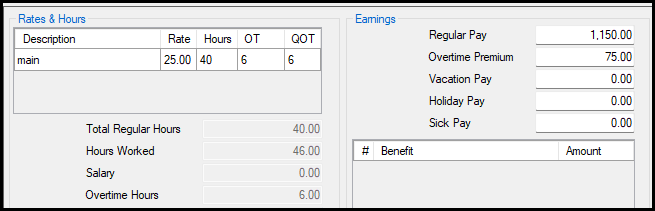
Enter overtime hours in the OT field towards the left of the screen (do not include overtime hours in the regular Hoursfield). The required overtime amount is calculated and displayed in the Earnings grid. The overtime rate and the pay rate to which it applies are what you previously set up for the employee.
-
Enter the Qualified Overtime hours in the QOT column.
Note The OT is used for wage calculations. QOT is for tracking purposes. QOT should not exceed OT.
-
Once all fields are complete, click Save to apply your changes.
Tip Use the Check Info button to see individual check QOT Hours and Amount.
Go to Payroll > Manage Qualified OT to adjust values for multiple employees for a selected Period End Date.
-
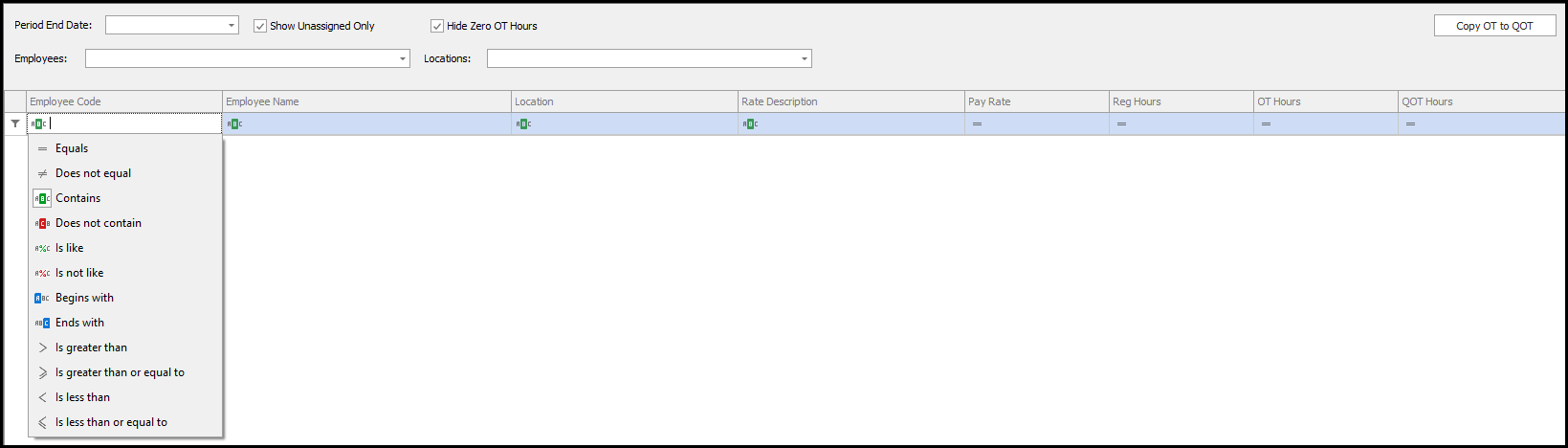
If you do not see any employees in the list, toggle the options Show Unassigned Only and Hide Zero OT Hours.
-
You can also search or filter using the column headers:
-
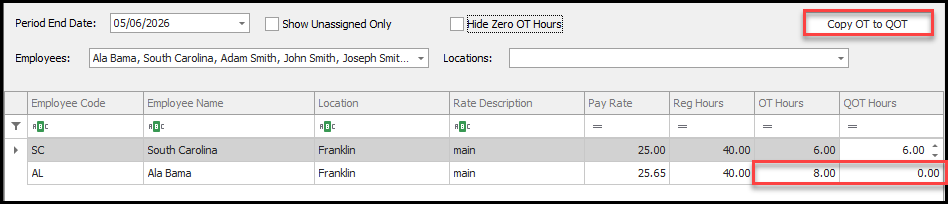
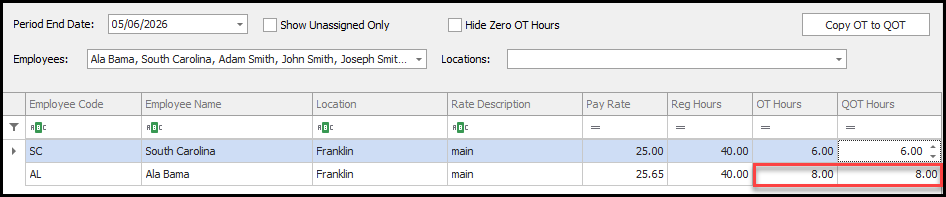
If there are employees listed that do not have QOT Hours assigned, you can click the option Copy OT to QOT to have the QOT amounts populated based on the amounts in the OT column for each check in that period.
-
You can also click on the grid directly to make edits to the QOT Hours.
-
When you have completed your edits, click Save.
Overtime Report
Overtime hours and pay will be displayed in the Hours Report (Employees > Reports > Total Overtime Report).
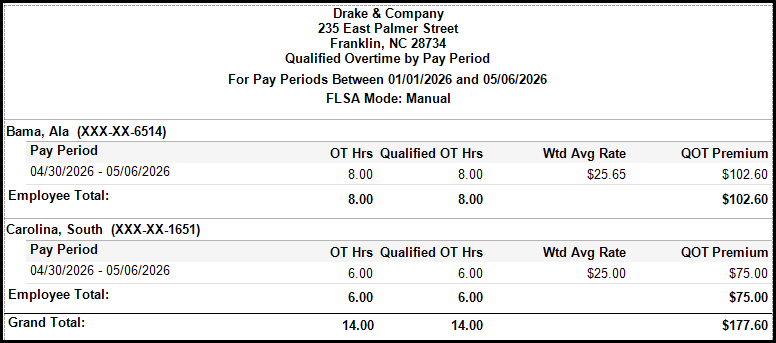
Go to Reports > Qualified Overtime in Pay Period to run a report that shows Overtime hours and pay by pay period. Select your report options, then click Run Report.
DAS 2025
For tax year 2025, employers are not required to separately report or account for qualified overtime compensation on Form W-2; however, employers may choose to include this information on:
-
Form W-2, Box 14, or
-
A separate accompanying statement.
You would need to manually calculate and enter the amount on Forms W-2 created in DAS 2025. Alternatively, you can attach a statement that you create outside DAS. You can use the Total Overtime report to see the overtime hours and pay for each employee (go to Employees > Reports > Total Overtime Report). Please note that the total overtime may not be the same as qualified overtime.
Related Links
Note This new tax bill, was signed into law on July 4, 2025. The One Big Beautiful Bill Act (OBBB or OB3) is also referred to by lawmakers as the Working Families Tax Cut Act. You may see one or both names used, but they refer to the same set of tax changes.